Spec over Prompt: Agentic Engineering That Survives Production
Agentic engineeringOpenSpecSpec-drivenSDLCCursorAiEngineeringProductivity
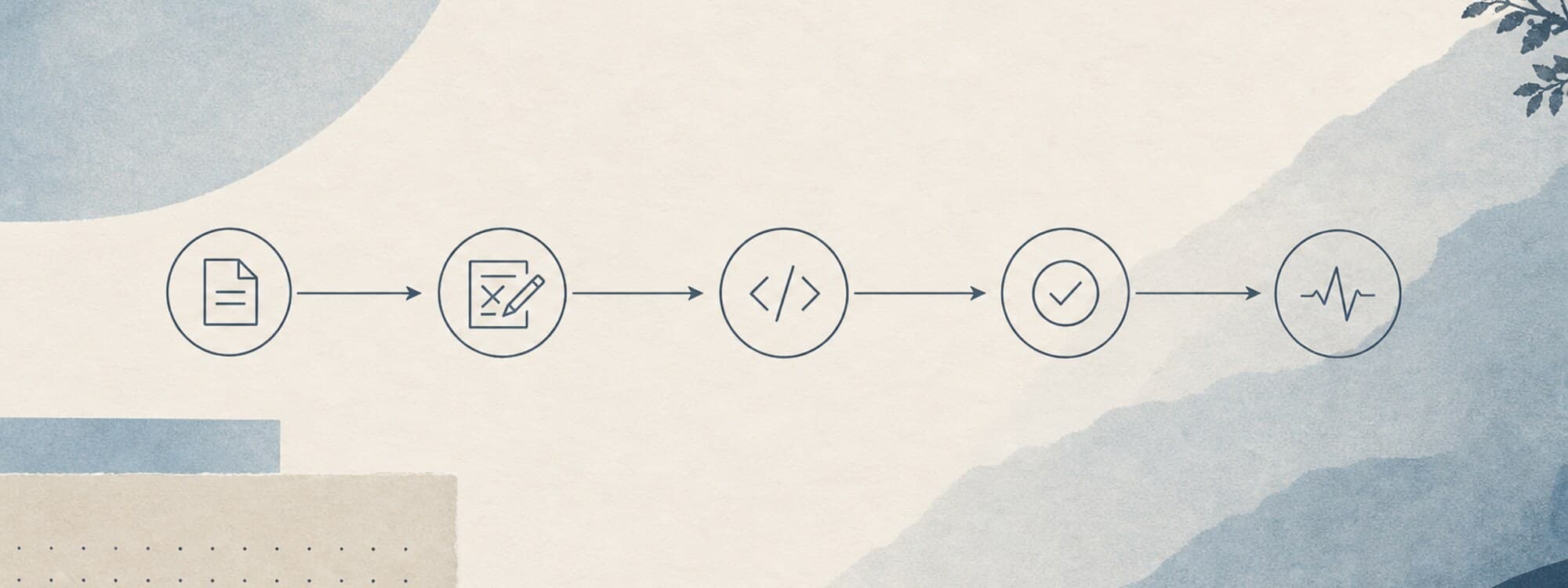
Editorial-style header illustration for this article (placeholder reuse; swap when a dedicated asset is ready).
Spec over Prompt: Agentic Engineering That Survives Production
Vibe coding still feels magical.
You describe a feature, the model fills the editor, and for a moment it looks like software engineering got cheaper.
Then the PR lands in a real repo. The diff is unreviewable. Naming drifts. Existing patterns get reinvented. Acceptance criteria lived in a chat you already closed.
Production does not fail because the model is “bad.” It fails because prompt is not a system of record.
This post is the 2026 update to my agentic workflow: keep the discipline from earlier posts, and put a durable agreement layer in front of the agent — spec over prompt.
I already wrote the two halves of this story:
👉 Related: From Vibe Coding to Agentic Engineering
👉 Related: AI in Production: Agentic Engineering Across the SDLC
What was missing was a concrete spine for agreement — something agents can read, humans can review, and the next session can find without replaying chat history.
That spine is OpenSpec, run through Cursor. The teaching cut below comes from a live workshop on 17 Sep 2026 (Digitale Leute School, Module 3 — MVP Development with AI II): watch-only demo, Reveal deck, demo product Startlist, prepared change add-race-startlist.
Terms (tight)
Vibe coding — prompt → paste → tweak. Great for exploration. Fragile as a delivery system.
Agentic engineering — multi-step agents that use tools and the filesystem, with the human as architect: intent, constraints, acceptance.
Spec-driven — durable proposal, design, tasks, and spec deltas before code. Chat is a scratchpad. Files in the repo are the agreement.
If you only remember one line: the agent executes; the human owns intent, constraints, and acceptance.
The workflow that still holds
The pipeline from the first post still stands. I compress it here so we can extend it, not replace it.
- Structured story — context, requirements, edge cases, acceptance criteria before generation. Full and lightweight templates live in the vibe → agentic post; I will not republish them.
- v0 as design intent — fast UI exploration and optional starter PR. Not a paste-into-
mainartifact. - Cursor in the real repo — Plan mode against existing types, conventions, and architecture. Screenshots plus constraints beat “rewrite this component from scratch.”
- Architectural gatekeeping — simplify abstractions, kill duplicates, own state placement, reject TODO-shaped error handling.
- Verify, then merge — tests, CI, justified dependencies. Humans decide merge risk.
That workflow scales because design and integration are separated, and review is mandatory. What it still lacked was a shared memory across sessions and agents.
Map it to the SDLC
The second post maps the same idea onto lifecycle phases. The principle does not change:
The agent executes.
The human defines intent, constraints, and acceptance.
| SDLC phase | Agent role | Human role |
|---|---|---|
| Discovery | Expand and structure requirements | Set intent; kill ambiguity |
| Design | Rapid prototypes / design intent | Product and UX judgment |
| Implementation | Scoped code against the repo | Architecture boundaries |
| Verification | Surface regressions; propose fixes | Quality and risk gate |
| Operations | Faster triage scaffolding | Severity, rollback, learnings |
Without that map, AI usage becomes random prompts. With it, you get phase-specific outputs and explicit ownership. OpenSpec is how you make the early phases enforceable at agent speed.
The missing spine: OpenSpec
Chat is a terrible system of record.
It forgets. It forks. It cannot be reviewed like a PR. Two agents cannot reliably share the same intent unless that intent lives in files.
OpenSpec gives you two surfaces in the repo:
openspec/specs/— current truth about the systemopenspec/changes/<id>/— in-flight agreement for one change (proposal, spec deltas, design, tasks)
A change folder is the unit of review. Code is the consequence of an accepted change, not a substitute for one.
That is the thesis I keep repeating in conference cuts: spec over prompt. Prompting is how you talk to the agent. Specs are how the team — and the next agent session — know what “done” means.
The loop I teach (and use)
In Cursor (hyphenated slash commands):
/opsx-explore— think with the codebase; no commitment yet/opsx-propose— createopenspec/changes/<id>/artifacts- Human reviews the artifacts (this is the gate)
/opsx-update— fix bad requirements in the change, not in a new chat myth/opsx-apply— implement from tasks against the real repo/opsx-archive— fold deltas intoopenspec/specs/so the next change has memory
Two-surface gotcha that burns people in demos:
- Terminal:
openspec …(CLI) - Cursor chat:
/opsx-*(slash commands, hyphen)
Same spine, different entry points. If the room mixes them up, the loop looks “broken” when it is only mis-invoked.
Live 1 sketch — propose, catch, apply one slice
Workshop product: Startlist — brownfield replacement for a club’s race Excel. Spec the full system; ship one vertical slice.
That brownfield framing matters. Greenfield demos hide the hard part. In a real club workflow, Excel already “works,” people already have habits, and the agent will happily invent a second architecture next to the first unless the change folder constrains it.
Framing for the demo (not a production case study):
- One race
- A start list
- Mark a rider registered
- Persist in SQLite
- Auth stubbed
- Hosting, reimbursement, and the rest of the club ops later
Prepared change id: add-race-startlist.
Pedagogy that matters more than the tool names:
- Audience is watch-only — learn the loop, do not chase local setup mid-session
- Read acceptance out loud from Given / When / Then in the change specs
- Stop before the rabbit holes: tests as a separate gate, deploy, broad refactor
Typical Live 1 arc:
/opsx-proposeforadd-race-startlist- Catch one bad or over-scoped requirement in review (update the change folder)
/opsx-applyfor slice 1 only- Check scenarios against the written Given / When / Then — not against “what we meant in chat”
Saying the scenarios out loud sounds theatrical until you try it. Ambiguity dies faster when a human has to speak the acceptance criteria than when everyone nods at a markdown file.
That is spec over prompt in one sitting.
Live 2 sketch — parallel agents, one change folder
After the proposal is reviewed, multiple agents can read the same openspec/changes/add-race-startlist/ folder and work isolated streams (same idea as git worktrees: parallel execution, shared agreement).
The shared change folder is the point. Parallelism without a reviewed agreement is just concurrent vibe coding. Parallelism after review is how you spend agent speed without multiplying architecture drift.
Hard rule:
- Agents propose and apply
- Humans merge — no auto-merge theater
When the slice is done, /opsx-archive moves the durable bits into openspec/specs/. Skip archive and the next change starts amnesiac again. You are back to vibe, with better fonts.
Where teams break it
Most failures are still process failures — the same ones from the earlier posts, plus one new one that only shows up once you adopt a change folder:
- Vague intent — prompting from a feeling instead of a structured story
- Paste-as-ship — treating generated UI or a starter PR as production
- Invented architecture — agents creating patterns the repo already owns
- Merge without gates — skipping verification, or letting agents “finish” by merging
- Skip archive — change folders die;
specs/never learn
The pattern is familiar: speed without agreement. Agents make that failure mode louder, not different.
When that happens, teams blame the model. Usually the agreement layer never existed — or it existed in a chat thread nobody can review.
Minimum viable adoption
You do not need a process cathedral. Start with four non-negotiables:
- Structured requirements before generation
- Architecture-aware integration in the real repository
- Hard verification before merge
- A reviewed change folder before
/opsx-apply
That fourth item is the update. It is also the cheapest way to make parallel agents safe: they share files humans already accepted.
Codify how your team works in AGENTS.md / Cursor Skills / reusable review gates — the evolution of the .cursorrules homework I called out in the first post. Specs hold what; those files hold how we work here.
Takeaways
- Vibe coding fails in production because chat is not a system of record.
- Agentic engineering still means: agent executes; human owns intent, constraints, acceptance.
- OpenSpec makes that enforceable:
openspec/specs/for truth,openspec/changes/<id>/for in-flight agreement. - Run the Cursor loop: explore → propose → human review → update → apply → archive.
- Brownfield pattern: spec the system, ship one vertical slice; parallel agents may share a change folder; humans merge.
Closing
AI does not replace the SDLC.
OpenSpec makes the SDLC enforceable at agent speed — if you treat the change folder as the agreement and keep merge risk human.
If you want the longer tooling walkthrough, start with From Vibe Coding to Agentic Engineering. If you want ownership by phase, read Agentic Engineering Across the SDLC. This post is the spine that sits between them when you are ready to run the loop in a real repo.
I teach and speak on this material; if you are wiring agents into an existing delivery system and want a production-first cut, that is the conversation I care about.